3. Why Anti-Ableism in STEM Matters
STEM Spaces are not Neutral
Actua programs are designed to spark curiosity, build confidence, and help young people see themselves in science, technology, engineering, and math. These spaces can open doors, and can help youth develop skills, relationships, and a stronger sense of what might be possible for them in the future.
At the same time, STEM spaces are not neutral.
Like all learning environments, STEM spaces are shaped by ideas of social norms, values, and expectations that influence who is recognized as capable, who is supported, and who feels they belong (Carlone & Johnson, 2007; National Academies of Sciences, Engineering, and Medicine, 2024). These ideas shape who feels like they belong, often in ways that go unnoticed or feel “objective;” But they are not.
These ideas and patterns are shaped by ableism: a system that values certain bodies and minds over others. In STEM, this can show up in assumptions about who is “naturally good” at math or science, who can focus or communicate in expected ways, who can keep up with fast-paced environments, or who is seen as leadership-ready (National Academies of Sciences, Engineering, and Medicine, 2024). For example, who gets asked to demonstrate, who is given extra time, or who is seen as “struggling” are often shaped by these assumptions.
One widely used working definition of ableism was developed by Talila A. Lewis, a Black, queer, disabled, nonbinary, social justice activist and organizer. Talila defines ableism as:
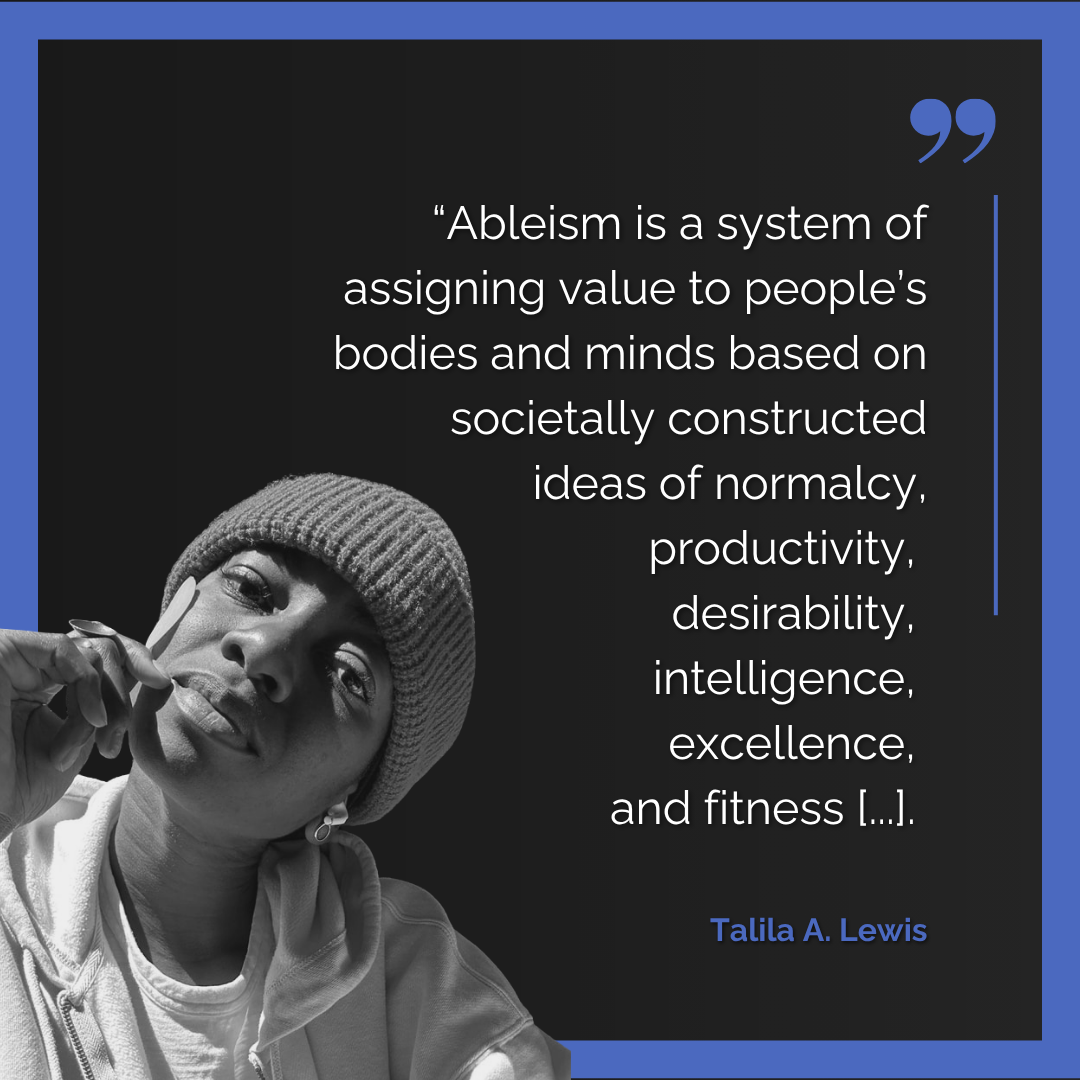
Image Description: A designed callout box featuring a quote by Talila A. Lewis that reads: “[...] Ableism is a system of assigning value to people’s bodies and minds based on a societally constructed ideas of normalcy, productivity, desirability, intelligence, excellence and fitness [...].” The quote is visually emphasized as a key takeaway. Offset from the text is a headshot of Talila A. Lewis in black and white.
This definition is not fixed. It has been shaped over time through community input. For this foundational module we are working with a shortened version. We encourage you to explore the full definition and its evolution: Talila A. Lewis: Working Definition of Ableism.
We will explore this concept more throughout the module, but for now what matters is recognizing that ableism is not only about individual attitudes, but about the assumptions and systems that shape how we understand ability, success, and participation. Ableism exists everywhere, including in STEM environments.
STEM programs help shape STEM Identity
STEM Identity matters because STEM programs do more than teach content; they also provide experiences and communicate meaning. STEM program environments shape whether young people feel safe to participate, ask questions, and imagine a future in STEM.
In other words, these environments help shape STEM identity – a young person’s sense that STEM is for them, that they can succeed in it, and that their ideas, ways of thinking, and lived experiences have value there. STEM identity is the sense that one belongs in STEM, that one is a scientist or STEM professional, and that others recognize that one belongs in STEM (Dou & Cian, 2022; Grimalt-Álvaro et al., 2022). If STEM is about solving problems and shaping the future, then who feels able to participate, and whose ideas are valued, matters a whole lot.
STEM needs more people with disabilities
People with disabilities remain underrepresented in STEM education and careers (National Academies of Sciences, Engineering, and Medicine, 2024). This is not due to lack of interest or ability, but because STEM environments (like many others) are often designed without people with disabilities in mind.
These experiences are not always the result of explicit barriers, but of everyday assumptions about competence, participation, and success that shape how people are perceived and supported (National Academies of Sciences, Engineering, and Medicine, 2024). These patterns are not accidental; they reflect broader systems that shape who is expected, supported, and valued in STEM.
Disability is rarely or explicitly framed as something that belongs in STEM.
Historically, much of research and design has focused on doing work on disabled people, studying, assessing, or designing for, rather than working with disabled people as contributors, knowledge holders, and learners (Hamraie, 2017; National Academies of Sciences, Engineering, and Medicine, 2024).
These patterns are not unique to any one program. They reflect broader dynamics across society, including STEM environments. That said, they can and should be changed.
Excluded from the Lab
If you would like to explore this further, the article Disabled scientists are excluded from the lab (Chemistry World) offers a short, tangible example of how laboratory design, timelines, and expectations can create barriers. Again, not because of a lack of interest or ability, but because environments are often not designed with disabled people in mind. Read the article: Disabled Scientists are Excluded from the Lab.
Disability is Here
Disability is not a niche issue that sits outside of your work. It is already part of Actua programs, teams, and communities.
Disabled people are present as participants, peers, co-instructors, leaders, parents or guardians, guest presenters, and partners. This also includes people with disabilities and those with access needs who may not use disability language to describe their experiences. Some disabilities may be apparent, while others are not. Some people may identify openly as disabled, while others may not use that language, may not feel safe doing so, or may still be making sense of their own experiences.
This matters because disability and ableism shape more than participant access alone. If we think about disabled youth only as recipients of help or support, we risk overlooking the reality that disabled people are also colleagues, caregivers, professionals, and community members whose experiences of STEM spaces matter too. We also risk, ignoring, minimizing or undervaluing important aspects of people’s identities. This omission can have influence over staff culture, expectations of families and guardians, communication practices, leadership opportunities, and the broader tone of a program.
Access Alone is Not Enough
Across the Actua network, many people work hard to improve access and remove barriers. This work matters because access and accessibility are essential for making participation possible.
In this module, accessibility refers to the design of environments, programs, and experiences so that people with a wide range of bodies, minds, and ways of engaging can participate fully, with reduced need to constantly request or justify their needs. Accessibility is essential, but access alone does not guarantee inclusion, belonging, or equity (Dolmage, 2017).
A program can be technically accessible and still communicate narrow assumptions about who is competent, independent, collaborative, or leadership-ready. A participant may be able to ‘enter the room’ and still feel underestimated. A parent or guardian may go through the accommodation request process for their child, and still feel that their knowledge is overlooked or that their child is treated as secondary. A staff member may have access needs met in one area and still experience stigma, lowered expectations, or silence in another.
Anti-ableism asks us to look beyond whether someone can technically participate and to consider what kind of experience we are creating once they are there.
Why Anti-Ableism Matters Here
Staff and leaders in all STEM environments, including yours, play an important role in shaping inclusive experiences.
Anti-ableism is not only about addressing bias or changing individual attitudes. It is about examining the assumptions, expectations, and everyday practices that shape program culture, often in subtle ways that can be easy to overlook.
Like a fish in water
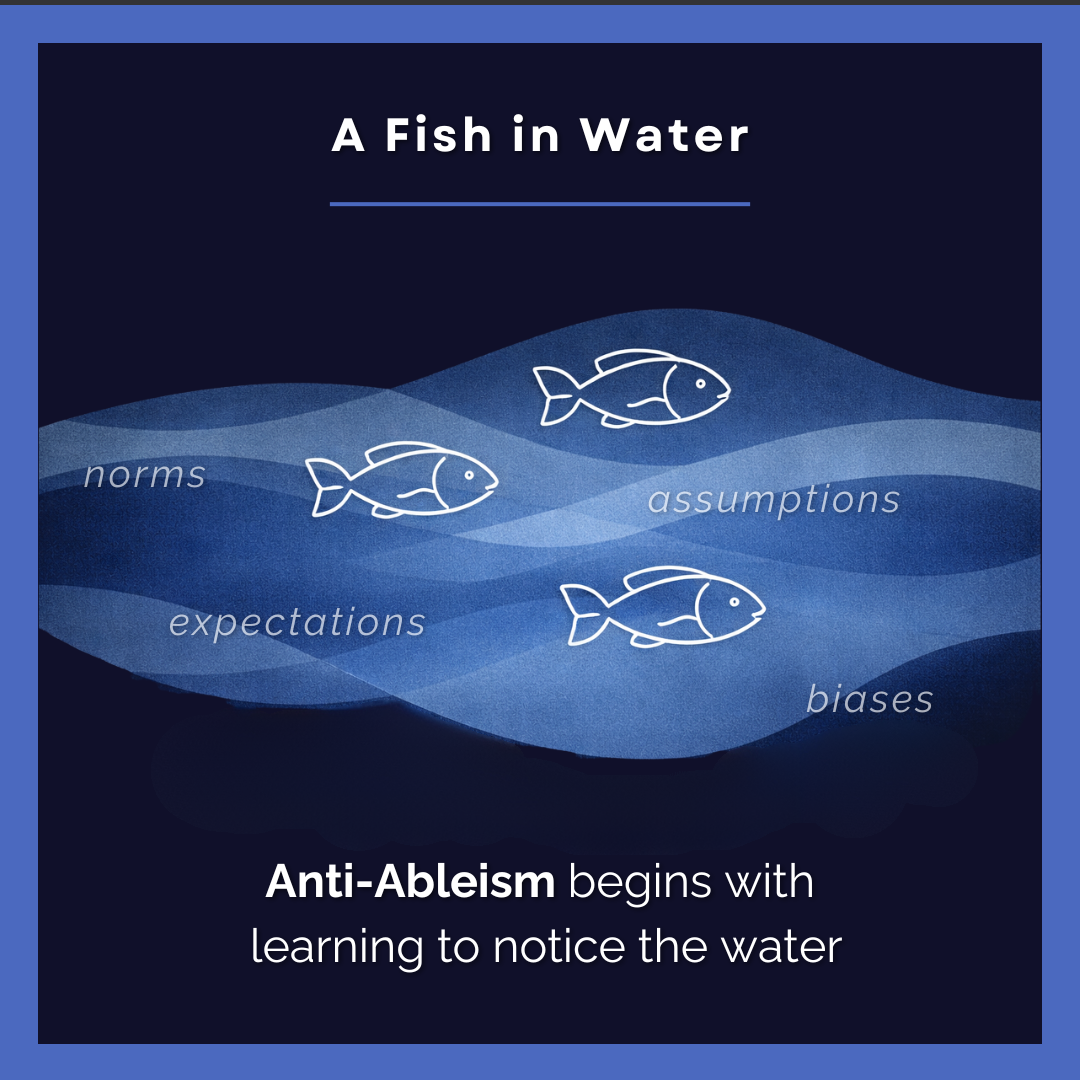
Image description: Three stylized fine-line fish swimming in the same direction, surrounded by words floating around them in layered shades of blue, suggesting water. Words read: norms, expectations, biases and assumptions. The graphic title reads: “A Fish in Water.” The subtext reads: “Anti-ableism begins with learning to notice the water.”
Fish don’t notice the water they swim in. It’s simply the ‘taken for granted’ environment around them.
In a similar way, ableism often operates as the unnoticed “water” in our programs and systems. It shapes expectations, norms, and decisions in ways that can feel natural or invisible, especially to those who are not directly impacted.
Anti-ableism begins with learning to notice the water.
When these patterns go unexamined, the impact is not only on individual experience. Entire ways of thinking, problem-solving, and understanding the world can be dismissed and excluded. This limits who enters STEM, who stays, and whose ideas shape what is built in the future.
Becoming anti-ableist means recognizing that culture is built in small moments and taking responsibility to create environments where more disabled youth, staff, caregivers, and community members can lead, contribute, and see themselves reflected in STEM.
Self-reflection
Before continuing, take a moment to pause and reflect. There are no right or wrong answers here; this is an opportunity to notice your starting point. While this module focuses on STEM contexts, and we’re tasking you with reflecting on how STEM-specific norms, cultures, and practices shape what disability looks like (or doesn’t) in these spaces, ableism is not isolated to any one field. You may notice moments where your reflections extend beyond STEM, and that’s welcome. Write your answers in your Becoming Anti-Ableist Workbook or a personal device or notebook.
- When you think about disability in STEM spaces, what comes to mind?
- Where have you noticed disability showing up, or not, in your programs?
- What “norms,” expectations, or assumptions feel natural or taken for granted in your STEM spaces? What might be part of “the water” in STEM?
- How might these norms shape who is seen as capable, valued, or leadership-ready?
- How might focusing on STEM both reveal and limit how you think about disability and ableism?
- What questions, uncertainties, or areas of curiosity are you bringing into this module?
You may wish to make a few notes. You will have an opportunity to return to these reflections later.
Up Next
To move forward, we need to expand how disability itself is understood, beyond a narrow definition or checklist.