5. Disability Storylines: Challenging Assumption and Stereotypes
As disability justice advocate Alice Wong writes: “being visible and claiming a disabled identity brings risks as much as it brings pride.” (Wong, 2020)
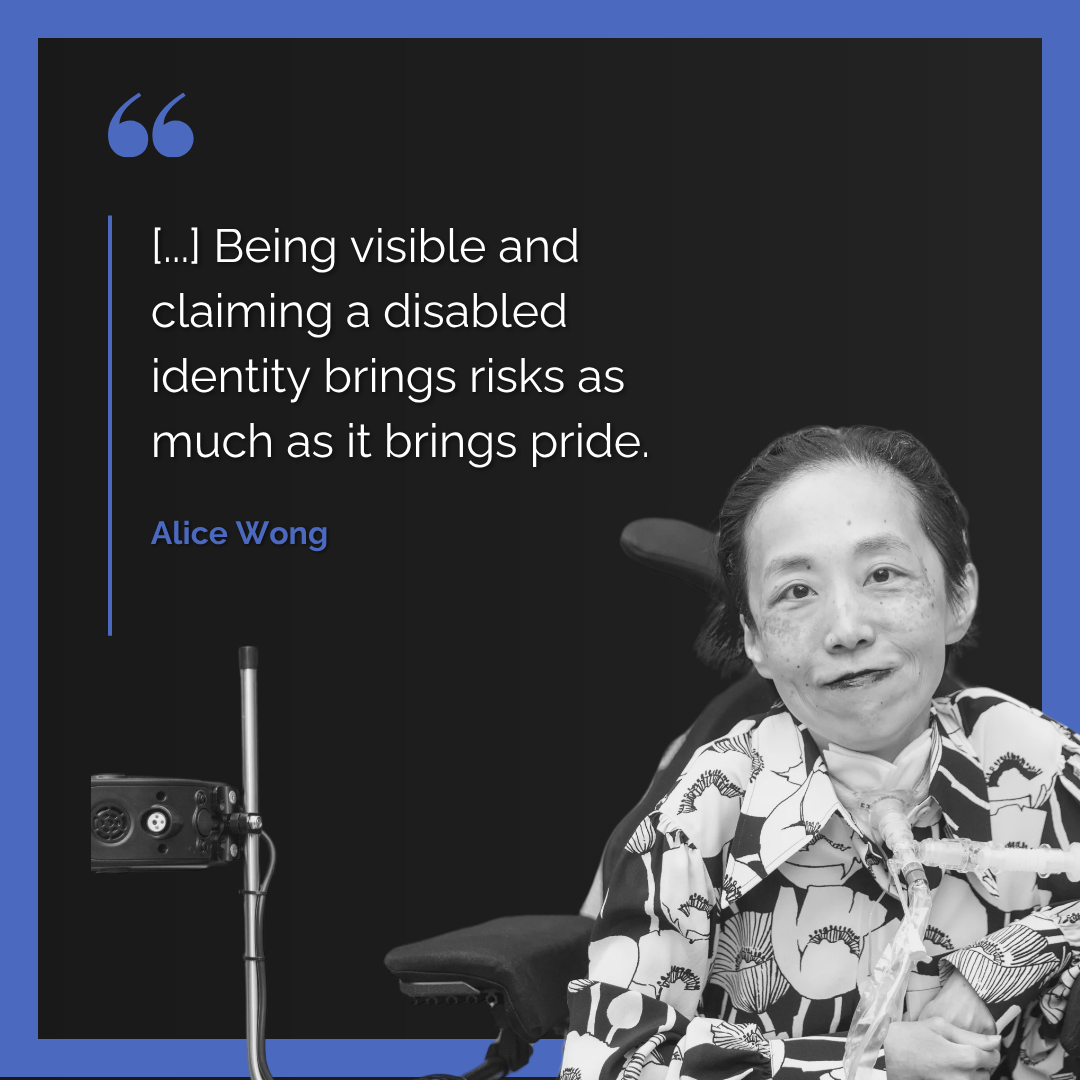
Image Description: A designed callout box featuring a quote by Alice Wong that reads: “[...] Being visible and claiming a disabled identity brings risks as much as it brings pride.” The quote is visually emphasized as a key takeaway. Offset from the text is a headshot of Alice Wong in black and white.
The risk does not come from disability itself, but from the meanings attached to it. These meanings show up as storylines: the stereotypes, assumptions, expectations, and snap judgments about who someone is, what they need, and what they are capable of.
Even with good intentions and a growing understanding of access needs and of disability, if unchecked, these limited assumptions and storylines about disability quickly shape our decisions and actions (Staats, 2016). The meaning we attach to disability has real consequences for how and for whom we:
- step in to help or give space to figure things out
- encourage and connect with
- redirect, overlook or ignore
In this module, we will interrogate common stereotypes or assumptions about disability that really get in the way of creating inclusive experiences. We refer to these as storylines.
What are storylines?
Storylines are the meanings, underlying ideas and assumptions we absorb and attach to disability. They are shaped by the environments we grew up in and move through including:
- our age, upbringing, and lived experience
- culture and community
- education and training
- media and representation
- policies and institutional practices (Garland-Thomson, 2009; Dolmage, 2017).
Before we dive into common storylines in more depth, it is critical to acknowledge that storylines about disability are not static, and do not impact everyone equally. People who are disabled and part of other equity-deserving or equity-denied communities (i.e. those who are racialized, Indigenous, queer, or living in poverty) experience compounding and intersecting forms of exclusion.
Intersectionality and disability
Intersectionality is a concept developed by legal scholar Kimberlé Crenshaw (Crenshaw, 1989) to describe how different forms of oppression overlap and interact to shape people’s experiences. In the context of disability, this means:
- a racialized disabled person may experience both ableism and racism
- a queer person with a disability may navigate ableism alongside homophobia or transphobia
- an Indigenous person with a disability may encounter ableism shaped by colonial systems and barriers
But intersectionality is not about simply adding lived experiences together, like a checklist or math equation. Instead, these systems of oppression interact, shape one another, and create unique barriers and realities (Collins & Bilge, 2016).
For example, a queer disabled person attending a Pride event may feel a strong sense of belonging in their queerness. But if accessibility hasn’t been considered, like sign language interpretation, quiet spaces, or accessible routes, they may still be excluded.
At the same time, a disability-focused event may prioritize physical access, but overlook things like pronouns in registration or gender-neutral washrooms making it harder for queer or trans participants to feel fully seen.
In both cases, inclusion is partial, and people are left to navigate which parts of themselves show up and which parts are left out. These dynamics are shaped by power, not just difference. Each space has a default in mind, and people who live at the intersection are expected to adapt, split themselves, or navigate those gaps on their own. Understanding this helps us move beyond one-size-fits-all approaches to inclusion. Intersectionality asks us not only to notice who is excluded, but to question who our spaces are designed around in the first place.
Intersectionality & Disability Video
Video: Intersectionality & disability, ft Keri Gray, the Keri Gray Group (2:11) - Captions available.
In this short video, disability advocate Keri Gray speaks directly to the camera, sharing how disability intersects with other identities, including race and gender, to shape people’s experiences. Key phrases appear on screen as she speaks, reinforcing her message.
Drawing on her lived experience as a Black disabled woman, she describes how these identities cannot be separated, and how systems that address only one dimension at a time often fall short of creating meaningful inclusion. She speaks about the Black Lives Matter movement as a positive example of intersectional change efforts.
Building on the concept of intersectionality, developed by Kimberlé Crenshaw, this perspective reinforces that ableism does not operate in isolation, but alongside other systems of power, shaping one another and creating unique barriers and realities.
Common Storylines about Disability
There is no single storyline about disability. While we highlight six widely pervasive storylines in this module, there are many more not covered here. Depending on the nature of one’s disability and access needs, they (you) may face a unique and specific stereotype that is not highlighted here. You can imagine that the meaning or stereotypes often associated with one person’s experience, with schizophrenia or facial difference for example, might be unique to those perpetuated for another person’s experience with ADHD or acquired hearing loss.
These storylines reflect widely documented patterns in disability representation and stigma across media, education, and policy (Garland-Thomson, 2009; Hehir, 2002). These storylines may be difficult to read. Whether you have lived experience of disability, love someone who does, or have experienced marginalization in other ways, these may land hard. Take care as you move through them.
1. Broken
Disability is understood as something wrong that needs to be fixed, improved or corrected. This leads to the perception that disability is wrong and tragic, and an expectation that disabled people should strive for a cure, or hide their disability (mask) to ‘fit in’.
This can show up when instructors focus on fixing or correcting participants, rather than adapting the environment or activity, and when difference is treated as a problem to solve instead of part of human variation.
2. Burden
Support needs are interpreted as ‘extra work’, a nuisance, inconvenient, and complicated. This leads to a perception that including disabled people is hard, comes at a significant social and economic cost, and whether it is ‘worth the effort’.
This can show up when instructors lower expectations. This can create what we might think of as an ‘expectation gap’; a significant difference between what disabled people are capable of and what they are expected or supported to do. This can lead to not offering opportunities, or assuming participation will be “too difficult”.
3. Childlike
Regardless of age, disabled people are perceived as less capable, less mature, naïve, cute and innocent. Sometimes this frames people with disabilities as eternally happy, incapable, unserious, and in need of protection.
This can show up when instructors simplify language unnecessarily, speak over participants or peers, or make decisions on their behalf, rather than engaging them as capable and self-determining.
4. Helpless
The autonomy and capabilities of people with disabilities are underestimated, and perceived as fragile, incompetent, and needing to be cared for and protected.
This can show up when help is offered without being asked, when independence is assumed to be absent, or when participants are not given space to try, struggle, or lead.
Optional Extension - The Complications of Kindness
To deepen your understanding of this concept, we invite you to explore Sitting Pretty: The View from My Ordinary Resilient Disabled Body by Rebekah Taussig.
In particular, Chapter 7, “The Complications of Kindness,” offers a powerful reflection on how well-intentioned actions can reinforce assumptions about helplessness.
If you choose the audiobook, you’ll hear Taussig narrate it herself, bringing her stories to life in her own voice.
5. Scary
Disabled people are perceived to be angry, unstable, dangerous and volatile. Disability is perceived as unfamiliar, uncomfortable, disturbing, difficult, or a reflection that a person with a disability is evil, a villain or cursed.
This can show up when behaviour is interpreted as threatening or disruptive without curiosity, leading to increased control, removal from activities, or a focus on compliance over understanding.
6. Inspirational
Disabled people are valued for being resilient, brave, exceptional, or for “overcoming,”. Reduced to “mascots” of inspiration, people with disabilities are valued for how they motivate non-disabled people, and are often expected to achieve greatness to prove their worth.
This can show up when disabled participants are over-praised for simply being present or completing the same tasks as their peers, rather than for their ideas, skills, or contributions.
“We’re the Superhumans” – Paralympic Games Advertisement
Video: We're The Superhumans | Rio Paralympics 2016 Trailer (3:12)
Captions available; Visual description available: We’re Superhumans Paralympic Games Advertisement Visual Description
Created by the UK broadcaster Channel 4 to promote its coverage of the Rio 2016 Paralympic Games, this advertisement features a high-energy montage of disabled people shown in both elite sport and everyday activities, set to the song “Yes I Can.” The video moves quickly between scenes of athletic performance, daily life, and musical performance.
The ad was praised by some for its visibility, energy, and celebration of disabled talent. At the same time, some disability activists questioned whether it reinforced pressure to be exceptional, raising questions about whether disabled people are being valued for who they are, or for what they can do.
Together, these responses reflect the complexity of representation, and how the Inspiration storyline can show up in layered and sometimes contradictory ways.
An additional thread to notice: Invisibility
Often, disability is not named, engaged with, or meaningfully considered at all. This can show up as silence, avoidance, or ‘neutral’ language that softens or redirects (e.g. special needs, all abilities, exceptionalities). While well intentioned, in these moments, disability and disabled people become invisible.
How Storylines Work Together
These storylines do not operate in isolation. They compound, often quickly and unconsciously shaping what we expect, how we interpret behaviour, make decisions, and design our programs. They influence the tone of our interactions and can have a significant impact on who feels like they belong, and who feels dismissed or like they need to work harder to be accepted. They begin to shape not just individual interactions, but broader patterns:
- Who is seen as capable or “a good fit”.
- Who is hired, trusted, or promoted.
- Who is taken seriously in leadership, science, or decision-making.
- Who is supported, and who is quietly filtered out.
What can seem like small, everyday decisions begin to stack into consistent outcomes.
The Power of Noticing
When left unexamined, storylines become part of how systems function. They uphold and shape program design, expectations, policies, and definitions of success. not just individual actions.
This is how ableism is reproduced and sustained, even in environments that are well-intended.
It is critical to notice where and how these storylines show up, to catch them in real time and begin to question them. Part of this work is to acknowledge that we all carry these storylines. This doesn’t make us bad people, but it does mean we are responsible for doing the work to understand how they are influencing our decisions, expectations and interactions
Disabled People Carry Storylines About Disability Too
Disabled people are not exempt from carrying these storylines. This can show up in a few ways:
First, in the same ways they show up for anyone; through assumptions, judgments, or decisions about others. This can sometimes look like dismissing or minimizing another person’s needs or experiences; for example, “their needs aren’t as important as mine.” This is sometimes referred to as lateral ableism or horizontal oppression, where harmful ideas are enacted within a community, not just from the outside.
Second, because these storylines are so widespread, many disabled people also internalize them. This is often referred to as internalized ableism (Campbell, 2009). Internalized ableism can shape:
- how people perceive themselves
- what they expect of themselves
- how safe or possible it feels to ask for support, take up space, or participate fully.
In some cases, this can lead people to mask, overcompensate, or avoid situations where they anticipate being misunderstood. For example: “I really want to go to that event or program with my non-disabled best friend, but I don’t want to be a bother by asking for my access needs”
In this scenario, the person could receive support, but the ‘burden’ storyline makes it hard to bring it up. Like all of the storylines we’ve explored, this is not about individual fault. It reflects the broader environments and messages people are moving through.
Pause and Reflect
In your Becoming Anti-Ableist Workbook or a personal device/notebook, reflect on the following questions:
- Which storylines feel most familiar to you? Where have these been perpetuated (e.g. movies, book, at work)?
- Where do you notice them showing up in your day-to-day interactions or decisions?
- Where might these assumptions be shaping who is thought of as capable, encouraged, or a “good fit” in STEM programs?
- What is one moment where you might pause and respond differently?
Up Next
In the next section, through the words and perspectives of disabled people themselves, we’ll define ableism and explore how these storylines create real experiences of ableism in STEM and uncover the impact they have on participants, families, and staff.