8. C.A.R.E. Framework
Anti-ableism asks us to notice what is happening and take responsibility for our role in it. The next step is action.
The C.A.R.E. Framework is a practical, iterative tool developed specifically for Actua to support this work. It is designed to help you move from being overly careful (trying not to get it wrong) to being full of care in how you design, respond, and lead.
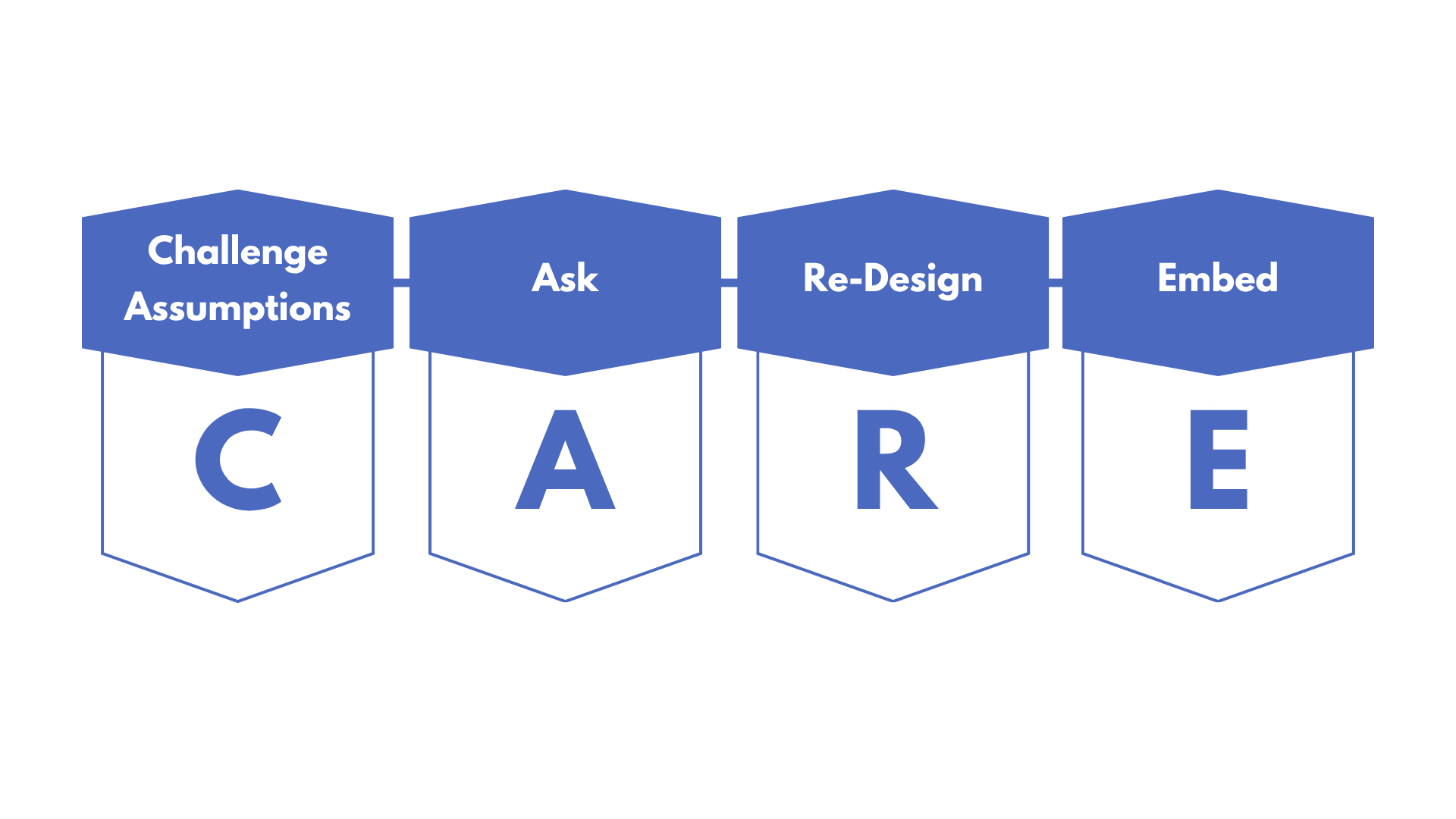
Image Description: The image presents a horizontal flow diagram made of four connected banner-like shapes in blue. Each section contains a step in a process labeled with both a word and a large letter beneath it. From left to right, the steps are: “Check Assumptions” (C), “Ask” (A), “Re-Design” (R), and “Embed” (E). The letters C, A, R, and E are displayed prominently below each corresponding label, forming the acronym “CARE.” The layout suggests a sequential process moving from left to right.
C.A.R.E. stands for:
- Challenge assumptions
- Ask
- Redesign
- Embed
You won’t always move through these in a specific order, and we hope they act as a useful guide to help you respond in real time, under pressure, and with incomplete information.
1. Challenge assumptions
By now you know that ableism often operates through assumptions, about behaviour, effort, ability, independence, and what participation “should” look like.
These assumptions are often automatic, and shaped by dominant norms, past experiences, and the storylines explored earlier in this module. Left unexamined, they quietly guide decisions about who is supported, who is challenged, and who is seen as capable.
Challenging assumptions means slowing down just enough to notice what is influencing interpretations of a situation that might be coming from you or your fellow leaders.
- What am I assuming right now?
- Where is that assumption coming from?
- Who is this expectation designed for?
This is about making sure assumptions do not operate unchecked. This is often the smallest shift, but it is where anti-ableism begins.
2. Ask
Once assumptions are visible, the next step is to ask. Asking moves you out of guessing and into relationship. It recognizes that people are the experts in their own experiences and that needs, preferences, and ways of engaging are not always visible. Asking is not a single moment, it is an ongoing practice of checking in, listening, and adjusting over time. Asking also creates responsibility. When someone shares what they need, it requires a response.
This includes:
- Asking before deciding what someone needs
- Asking everyone, not just those who “stand out”
- Checking in, in ways that respect dignity, autonomy, and privacy
This also requires listening, being open and taking responses seriously the first time.
- What would make this work better for you?
- How would you like to approach this?
- Do you want support, or would you prefer to try by yourself?
Not everyone will respond right away. Past experiences including not being asked, listened to, or believed, will shape whether people feel safe to share. Some folks may share at a later opportunity once they get a sense if it’s worth it, if the culture, intent and actions afterward will be there.
3. Redesign
Redesign is where awareness and information turn into action. It shifts the focus away from ‘fixing individuals’ and toward adjusting environments, structures, and expectations so more people can meaningfully participate.
This might involve:
- Offering multiple ways to participate, contribute, or lead
- Adjusting pacing, structure, or instructions
- Rethinking how roles are assigned or how success is defined
- Creating space for interdependence, not just independence
Redesign does not require starting from scratch. It is often small, intentional changes that expand what is possible within an activity or program. Over time, thoughtful redesign reduces reliance on individual accommodations because inclusion is built into the design itself.
4. Embed
Embedding is what turns individual actions into sustained practice. Without it, inclusion remains inconsistent, dependent on individual effort or awareness in the moment.
Embedding means integrating what you’ve learned into how you consistently work.
This includes:
- Carrying forward what worked into future programs
- Building reflection into planning and debrief processes
- Sharing learning and responsibility across your team
- Advocating for shifts in program or organizational practices
It also introduces accountability; a shared commitment to doing better over time.
This is where anti-ableism truly moves beyond individual moments and begins to shape culture, expectations, and systems.
C.A.R.E. in practice
The following case studies are informed by a pilot that IX ran with 300 Actua network member instructors across three network member sites in 2025. Participants shared examples of where ableism was showing up in their programming. These case studies draw on those examples, alongside themes from the letters.
Select one case from below or think of a situation from your own experience.
Using the C.A.R.E. framework, reflect on:
- Challenge – What assumptions are shaping how this situation is being interpreted?
- Ask – What questions could help better understand what is needed, and who needs to be asked?
- Redesign – What could be adjusted to create a more inclusive and meaningful experience?
- Embed – What would need to change so this improves over time, not just in this moment?
You can do this individually or with your team. Write your answers in your Becoming Anti-Ableist Workbook or a personal device or notebook.
Case 1 – Before the program even begins
Content note: Ableism, racism, assumptions, access
A camper’s registration form notes that they may need support with transitions and group activities. In a planning conversation, a staff member says: “Let’s keep expectations realistic. Maybe give them something simpler to start.”
No one has spoken directly with the camper or their caregiver yet.
The decision is being made early and shaped by limited information, time pressure, and a desire to prepare.
Case 2 – A staff member carrying more than you know
Content note: Ableism, chronic illness, fatphobia, workplace culture
A staff member is moving more slowly than others during a long, physically active day. They step away briefly between activities. Later, someone says: “We all need to pull our weight. It’s a busy camp.”
The staff member hasn’t shared that they are managing chronic pain. They’ve learned to keep it to themselves.
Case 3 – Caregiver communication and missed moments
Content note: Ableism, power, caregiver dynamics
At drop-off, a caregiver begins explaining what helps their child regulate in new environments. Your peer responds, “Thanks, we’ll keep an eye on it.”
The conversation ends quickly. Later, the participant struggles during a transition. In debrief, someone says: “We didn’t really know what they needed.”
Case 4 – Participation, but on whose terms
Content note: Ableism, neurodivergence, exclusion
During a group activity, a participant steps away, moves around, and returns intermittently. They are engaged, but not in the same way as others. A staff member pulls them aside for being “disruptive.” In the following days, you notice they are often in the sensory-friendly room.
Case 5 – When feedback doesn’t go anywhere
Content note: Ableism, team dynamics, normalization
In a team conversation, someone raises a concern about how a participant was supported during an activity. The response: “We’re all doing our best. It’s a busy day.”
The moment passes. No changes are made.
From individual action to collective practice
Anti-ableism is not something you carry alone. It strengthens when it is shared. As you complete this module, reflect on your responses in Section 3 and consider the following and write your answers in your Becoming Anti-Ableist Workbook or a personal device or notebook:
- What has shifted in how you understand ableism?
- Where do you now notice ableism or disability storylines in your own practice?
- What is one action you will take in your own anti-ableist practice?
- What is one conversation you can bring to your team?
- What is one change you would advocate for at a program or organizational level?
Activity: Wall of Practice
Anti-ableism is a collective practice with everyone working together towards anti-ableism. With your instructor team, or on your own, create a wall of anti-ableism practices:
Actua’s team completed this exercise by answering “What is one action you will take in your own anti-ableist practice?” Open Actua's answers in a new window: Wall of Practice: Actua Staff Answers.
Image description: An PDF titled "What is one action you will take in your own anti-ableist practice?" features a large dark blue header box with the title text in white. Below the header, five digital sticky notes in shades of blue and green display individual commitments: having more conversations with youth about anti-ableism, making space for different ways of communicating and participating, ensuring future presentations are as anti-ableist as possible, listening to the "Casual Ableism Talks" podcast weekly, and exploring diverse ways to share information during virtual webinars. A sixth green sticky note on the far right is blank, topped with the prompt "Add yours!" to encourage user participation. The Actua logo, a small "u" shaped smiley, sits in the bottom right corner.
Now it’s your turn to add to our “wall of practice.” In your Becoming Anti-Ableist workbook, write your response to your chosen reflection question on the blank note. Cut out the note and place it somewhere you will see daily during your work term. If you want to go digital, set a weekly reminder on your phone to reflect and remind you of your commitment to anti-ableism. If it feels right for you, share your commitment with others and help grow Actua’s community of anti-ableist learners, allies, and accomplices.
Closing
Becoming anti-ableist is not about getting everything right, it’s about choosing to notice, to challenge, and to keep improving.
It’s also important to mention that this work did not begin here. Disabled people, including youth, staff, leaders, and community members have been naming barriers, building alternatives, and pushing for change for a long time. This module is not the start of that work. It is an invitation to join it and take responsibility for your role within it.
Each decision you make contributes to what STEM spaces feel like, who belongs, and who is able to participate with dignity. As disability justice activist Mia Mingus (2017) reminds us:
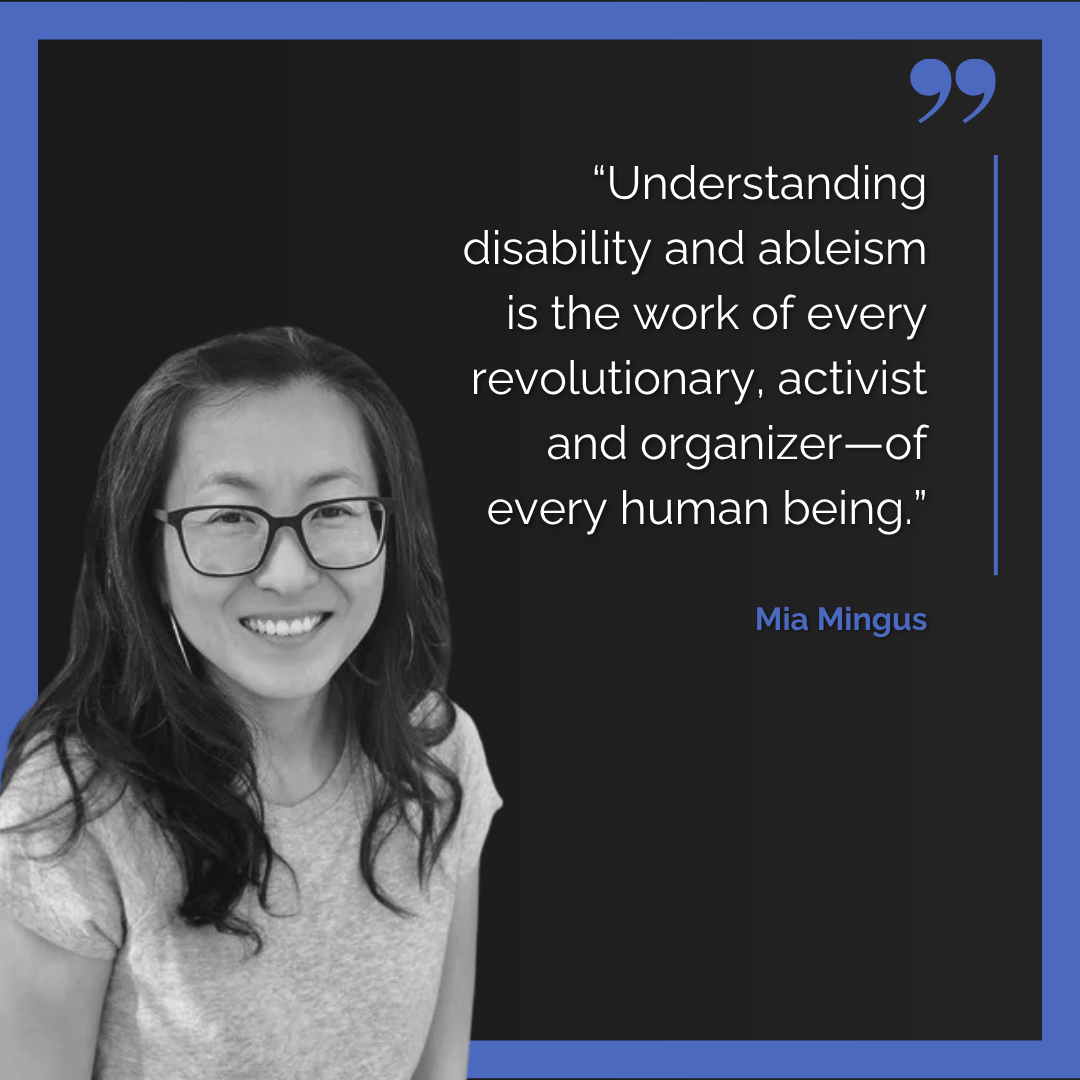
Image Description: A designed callout box featuring a quote by Mia Mingus that reads: “Understanding disability and ableism is the work of every revolutionary, activist and organizer – of every human being.” The quote is visually emphasized as a key takeaway. Offset from the text is a headshot of Mia Mingus in black and white.
You are accountable for what you do next.
If you’d like to continue your learning, you can find an ever-growing selection of resources (films, podcasts, books etc.), curated with care on the IX website: Inclusive Experiences: What We Love.
We invite you to stay with it and to stay in touch (email: Elisabeth@inclusive-experiences.ca or shawna@inclusive-experiences.ca). Please reach to let us know how this content landed with you, with any question, or feedback for how this module can be improved.
Thank you,
Shawna & Elisabeth