7. Anti-Ableism: Accountability and Action
In the previous section, you explored how ableism shows up in practice, through everyday decisions, assumptions, and ways of working. Through the letters you may have noticed where:
- Something small had a big impact
- Support came too late, or not at all
- Assumptions shaped what was perceived as possible
- Someone had to work harder than they should have just to participate
We also hope you noticed that ableism in STEM extends beyond participant experiences. Ableism impacts and is experienced by parents and guardians, loved ones, your peers and more.
At this point, the goal is not just to understand and recognise ableism, but to take accountability, and action to do something about it.
Why Good Intentions are Not Enough
Most people we encounter express a deep desire to be inclusive. They care deeply about doing it right. The STEM world is no different. Leaders and instructors want participants to feel welcome, and they want to get it right. And yet, good intentions can sometimes be part of the problem. When we center our intent (i.e. what we meant, what we were trying to do, how hard we are trying), we can lose sight of impact.
This can lead us to become defensive, dismissive and explain things away. We can begin to focus too much on our own efforts, and not enough on what people are really experiencing. This is one of the ways ableism continues, even in spaces that care deeply about inclusion.
Regardless of intent, these actions can still cause harm.
A Shift Toward Anti-Ableism
In this module and in our work at IX, anti-ableism is a practice of accountability and action.
It builds on work from anti-racism scholars and organizers, including Ibram X. Kendi (2019), who describes anti-racism not as a fixed endpoint or identity, but as an ongoing practice. A practice requiring individual and collective accountability, and defined by the actions we take.
Anti-ableism follows a similar approach, and requires:
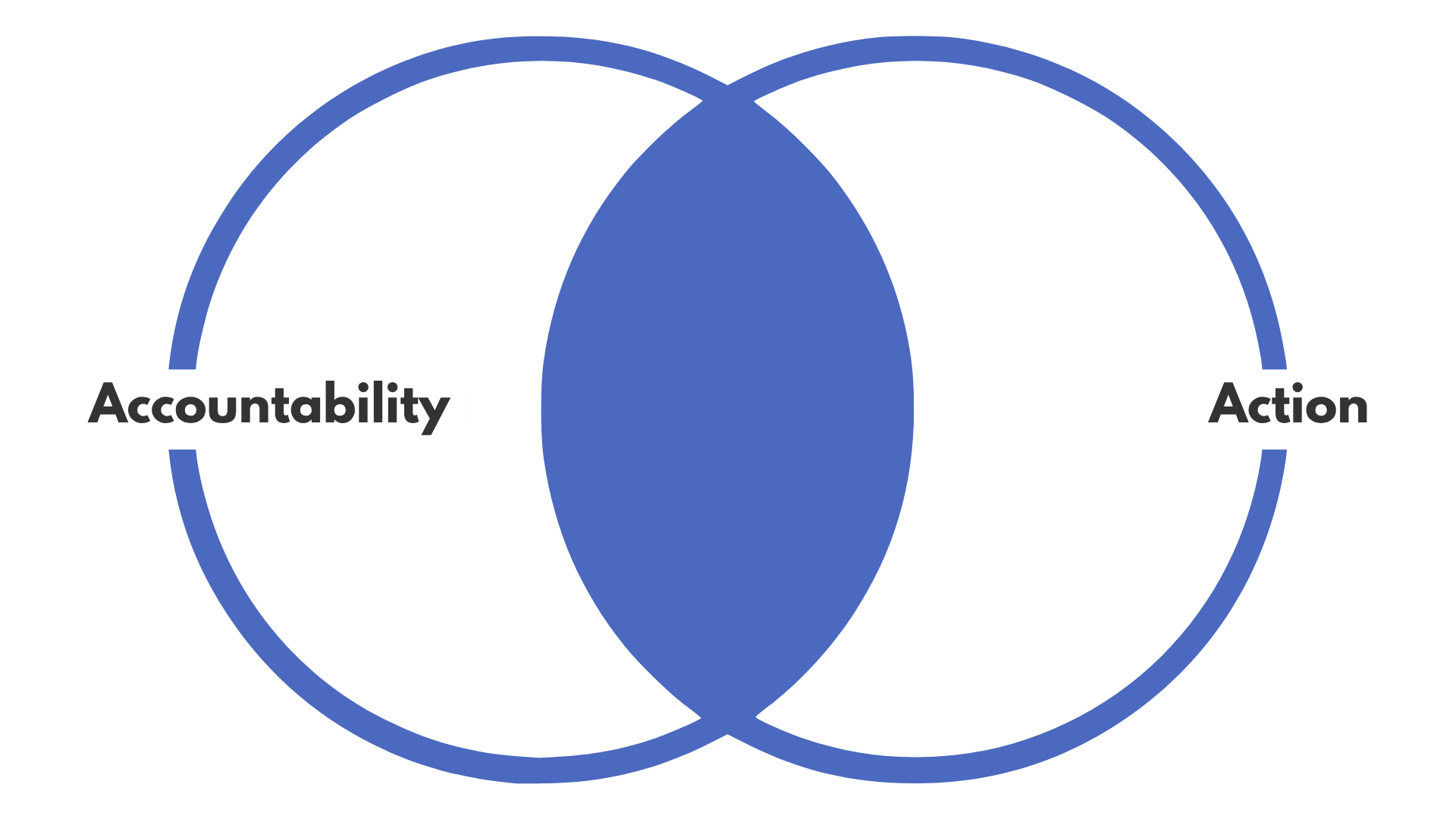
Image Description: Two blue circles overlap to form a Venn diagram. One circle is labeled “accountability” and the other is labeled “action.” The overlap highlights the connection between the two, suggesting both are required for anti-ableism action.
1. Accountability
Accountability means recognizing that your decisions, assumptions, and behaviours shape other people’s experiences, and taking responsibility for that impact. Anti-ableism requires accountability at multiple levels:
- Individual: How you show up and take responsibility for your own impact.
This includes noticing your assumptions, reflecting on patterns in your thinking and behaviour, continuing to learn, and making changes without waiting to be corrected. - Team: How you work alongside others to shape what happens in practice.
Regardless of your role (program delivery, leadership, or operations), everyone contributes to how environments are designed and experienced. This includes what teams normalize, what gets questioned, and how people respond when something isn’t working. - Organizational: How systems, structures, and priorities either reinforce or interrupt ableism. Organizations must recognize that ableism exists within their policies, programs, and norms, and take responsibility for addressing it. While you may not control these systems, you are often closest to the work and know where change is needed.
- Community: How this work extends beyond your organization into the broader spaces you are part of. This includes families, schools, sport, and community settings. Accountability at this level means applying what you’ve learned, influencing the environments around you, and inviting others into the work.
Accountability means paying attention across these levels and recognizing that even when you don’t control all of them, you are still part of how they function. It also means not placing the burden on disabled participants, families, or colleagues to continually identify barriers or advocate for change. This is not about blame or shame. It is about taking responsibility for the role you play within a system that already exists, and for how that system is experienced by others.
In practice, this might look like:
- Adjusting pacing or instructions based on how participants are engaging
- Checking assumptions before offering help or intervention
- Changing how success or participation is defined in an activity
- Inviting and acting on feedback, even when it is uncomfortable
2. Action
Action means making changes that can be noticed by others. Action shows up in how you:
- Design and adapt activities
- Introduce and explain expectations
- Respond to questions, needs, or challenges
- Make decisions in the moment
- Follow through on what you notice
These may be small shifts, but they accumulate over time. They are powerful in shaping whether someone feels like they belong, are capable, and can continue in STEM.
Accessibility and Anti-Ableism
Accessibility is essential.
It focuses on reducing or removing barriers so people can enter, participate, and stay.
This might include things like physical access, sensory considerations, flexible formats, or communication supports.
Many organizations are working to improve accessibility, and this matters.
But accessibility on its own does not guarantee a meaningful or equitable experience.
You can gain access to a space and still feel:
- Underestimated
- Excluded from decision-making
- Like you have to adapt yourself to belong
- Like you are being accommodated, but not valued
This is a tension that disability justice activists have long named. Access is not just about getting through the door; it is about what happens once you are there.
Or, put simply:
Access to what? And on whose terms?
In STEM programs, this can show up in subtle but important ways.
A participant may be able to complete an activity, but not be seen as a leader, have their access needs met, but still be spoken to or about differently, be included in the room, but not meaningfully included in the learning.
Accessibility might make participation possible, but Anti-ableism works to ensure that participation is meaningful, valued, and equitable.
What is within your control
As an Actua instructor, you may not control program policies, funding, or staffing structures, but you do play an important role in shaping what participants, families and your peers experience day-to-day.
You can influence:
- How safe it feels to ask for support
- Whether different ways of learning and participating are welcomed or corrected
- How mistakes, questions, and differences are responded to
- Whose contributions are recognized and built on
Anti-ableism is not a fixed state, and although tempting, it’s not helpful to think in terms of “ableist” vs. “anti-ableist” people or programs. That framing can shut down reflection and create defensiveness. Instead, this work exists along a continuum.
In any given moment, actions may reinforce ableism, interrupt ableism, or shift the underlying conditions that produce it. There will be moments where you feel uncertain, miss something or get it wrong. What matters most is what happens next. Do you notice? Do you own it? Do you adjust and do something differently next time?
Anti-ableism is not just about how you think differently. It is about what you do differently in response.
Anti-ableism is an ongoing process, and we hope you will continue to grow your practice over time and encourage more people to do the same.
Pause and reflect
Before moving to the next section, take a moment to consider:
- What is one thing you are already doing that supports more inclusive experiences?
- What is one thing you could shift, try, or do differently moving forward?
- Where might you need to involve others (your team, organization, or community) to create meaningful change?
Write your answers in your Becoming Anti-Ableist Workbook or a personal device or notebook.
Up Next
Taking action can feel uncertain, especially when you are working within existing systems or limited resources. In the next and final section, we introduce the CARE Framework, a practical tool to help.